
The landscape of digital marketing has fundamentally transformed. Search engines are no longer simple keyword-matching machines; they’re intelligent systems powered by Natural Language Processing (NLP) and artificial intelligence that understand context, intent, and meaning in ways that would have seemed like science fiction just a few years ago.
For ketamine clinics and practitioners looking to attract patients through organic search, this evolution is both a challenge and an extraordinary opportunity. The old SEO playbook, stuffing content with keywords and hoping for the best, is not just outdated; it’s actively counterproductive. Today’s search engines, particularly those powered by AI, like ChatGPT, reward content that provides genuine value, answers real questions, and demonstrates a deep understanding of what potential patients actually need.
This comprehensive guide explores how to optimize your ketamine clinic’s content for AI-driven search engines, ensuring your practice reaches the patients who need your services most.
Understanding Artificial Intelligence and Its Impact on Search
Before diving into optimization strategies, it’s crucial to understand what the artificial intelligence field of NLP actually is and why it matters for your ketamine clinic’s online visibility.
What Is Natural Language Processing?
Natural Language Processing is a field of artificial intelligence that focuses on the interaction between computers and human language. In the context of search optimization, NLP fundamentally changes how search engines interpret, understand, and deliver results to users.
Traditionally, search engines operated on a relatively simple principle: they matched exact keywords from a user’s search query to keywords present on web pages. This approach had significant limitations. It couldn’t understand synonyms, couldn’t grasp the nuance behind different ways people express the same idea, and couldn’t determine a user’s actual motivation for searching.
For a ketamine clinic, this meant that if someone searched “ketamine infusion therapy near me,” the old search system might struggle to connect that query to content about “IV ketamine treatment for depression,” even though these phrases describe the same service. The modern, NLP-powered search engine understands the semantic relationship between these phrases and can match the searcher with relevant content.
How NLP Changes Search
Modern search engines powered by NLP accomplish several things traditional search engines couldn’t.
Understanding User Intent
Instead of just seeing literal words, NLP algorithms decipher what the user is actually looking for. When someone searches “how can ketamine help with treatment-resistant depression,” the search engine understands this isn’t just a collection of words; it’s a question from someone seeking educational information and potentially patient testimonials about ketamine therapy’s effectiveness.
Grasping Semantic Meaning
Human language is complex, with synonyms, context-dependent meanings, and varied sentence structures. NLP allows search engines to recognize relationships between words and phrases. It knows that “ketamine infusion therapy,” “IV ketamine treatment,” and “ketamine-assisted therapy” are discussing the same topic, even though the exact wording differs.
Interpreting Context
NLP helps search engines consider broader context surrounding a query. If someone searches “ketamine clinic,” then “what should I expect during treatment,” then “recovery time after ketamine infusion,” a modern search engine understands these queries are connected and can provide contextually relevant results for the entire patient journey.
For ketamine clinics, this means your content strategy must align with how potential patients naturally think and communicate about your services.
Why NLP and AI Search Matter for Your Ketamine Clinic
The implications of NLP-driven search for your ketamine clinic are significant and multifaceted.
Enhanced Search Accuracy and Patient Reach
NLP-equipped search engines can recognize subtle meanings and provide more relevant search results, which directly translates to higher click-through rates and conversions for your practice. By understanding both what potential patients are asking and why they’re asking it, you can align your messaging precisely with patient intent.
For example, someone searching “ketamine treatment for bipolar depression” is likely a different prospect than someone searching “ketamine therapy cost.” The first person is in the educational phase and may be skeptical; the second is already considering treatment and is evaluating financial feasibility. Modern NLP allows search engines to match these different queries with appropriately tailored content, and it allows your clinic to provide that content.
Better User Experience
Today’s potential patients expect quick, clear, and personalized answers to their queries. When someone researches ketamine treatment, they’re likely anxious, desperate for relief, or simply uninformed about what to expect. Optimizing your content with NLP in mind creates a seamless journey that addresses their specific concerns, keeps them engaged, and builds trust.
This approach aligns with changing search behaviors. Patients are increasingly using voice search (“Alexa, find ketamine clinics near me”), long-tail conversational queries (“Is ketamine treatment safe for people with heart conditions?”), and multi-step search journeys as they move from awareness to consideration to decision.

Increased Reach Across Devices and Search Behaviors
With billions of voice assistant-enabled devices in active use, your content must perform well across multiple touchpoints. A patient might search for ketamine information on their smartphone during a lunch break, ask a voice assistant about side effects while driving, and later review your website on their desktop. NLP-powered optimization ensures your practice maintains brand visibility and delivers coherent messaging regardless of how patients are searching.
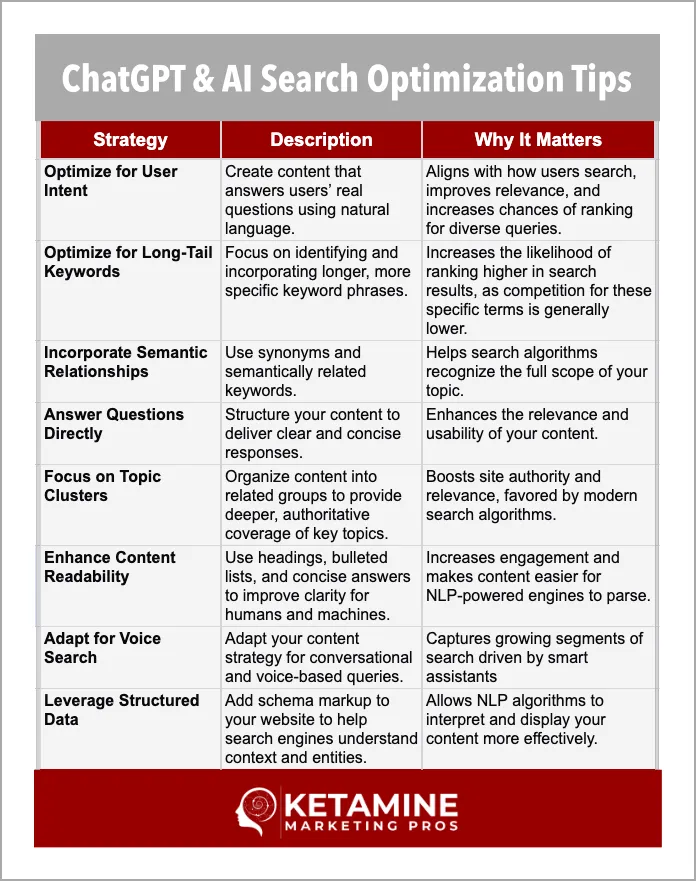
Proven ChatGPT and AI Search Optimization Strategies for Ketamine Clinics
Now that we’ve established why NLP matters, let’s explore specific, actionable strategies for optimizing your ketamine clinic’s content.
1. Optimize Content for User Intent
This is perhaps the most critical shift from traditional keyword-focused SEO. Instead of simply targeting keywords, focus on truly understanding what potential patients are looking for when they search.
For a ketamine clinic, user intent varies significantly:
Educational Intent
Someone searching “how does ketamine work for depression” is seeking to understand the mechanism of action. They may be early in their consideration process.
Safety Intent
Searches like “is ketamine treatment safe” or “ketamine side effects” indicate someone who’s interested but concerned. They need authoritative, reassuring information.
Logistical Intent
Queries such as “ketamine infusion appointment near me” or “how long does ketamine treatment take” indicate someone ready to take action.
Comparison Intent
Searches like “ketamine vs. traditional antidepressants” show someone evaluating options.
Your content strategy should address each of these intents with dedicated, thoroughly researched content pieces. A single blog post titled “Ketamine Treatment” won’t work. You need specific content addressing specific questions potential patients are asking.
Use keyword research tools and platforms that reveal intent-driven queries. These tools help you understand not just what people search for, but what they’re actually trying to accomplish. For ketamine clinics, this might mean identifying that 40% of queries about your services come from people struggling with treatment-resistant depression, while 20% come from people interested in ketamine for chronic pain, and so forth.
2. Focus on Long-Tail Keywords and Conversational Phrases
Rather than competing for broad, generic terms like “ketamine treatment” (which will be dominated by large medical institutions and pharmaceutical companies), focus on specific, conversational phrases that reflect how real potential patients actually search.
Long-tail keywords for a ketamine clinic might include:
- “What is ketamine therapy used for?”
- “How much does ketamine treatment cost?”
- “Can ketamine help with anxiety disorders?”
- “Ketamine infusion therapy for PTSD near Phoenix”
- “How many ketamine sessions will I need?”
- “Is ketamine treatment covered by insurance?”
- “What should I expect during my first ketamine infusion?”
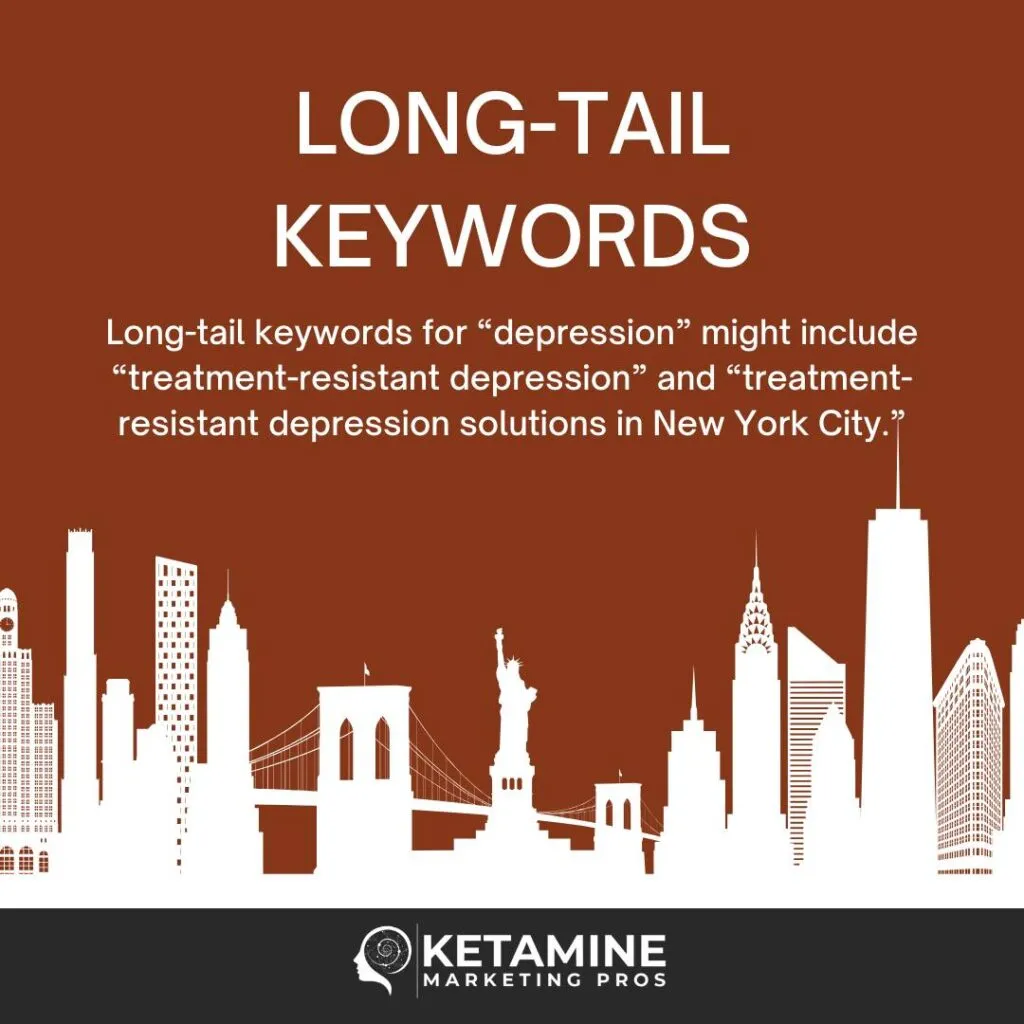
These longer, more specific phrases have several advantages:
Lower Competition
Fewer websites target these specific phrases, making it easier to rank.
Higher Intent
Someone searching “ketamine treatment for OCD” is much more likely to be a qualified patient than someone searching “ketamine.”
Better Conversion Potential
Specific queries indicate someone further along in their decision-making process.
Natural Language Alignment
These long-tail phrases sound like how humans naturally speak, which is exactly what NLP algorithms reward.
By weaving these conversational, intent-driven keywords seamlessly into your content, you align better with how modern search engines interpret and deliver results, ultimately boosting visibility, engagement, and patient conversions.
3. Incorporate Semantic Relationships and Related Concepts
Semantic optimization means using synonyms and semantically related keywords throughout your content to enrich its context and depth.
For a ketamine clinic, semantic relationships might include:
Core Topic
Ketamine-assisted therapy for depression
Related Terms
IV ketamine infusions, ketamine treatments, KAT (ketamine-assisted therapy), esketamine (Spravato), treatment-resistant depression, major depressive disorder, therapy-resistant depression
Contextual Variations
Patient experience, clinical outcomes, efficacy rates, safety profile, side effects, recovery time, treatment protocol
Instead of writing content that simply repeats “ketamine treatment” over and over, naturally incorporate these related terms. This helps search algorithms recognize the full scope of your topic and increases the likelihood your content appears for diverse yet related search queries.
For example, a comprehensive blog post about ketamine for depression might discuss:
- How ketamine differs from traditional antidepressants
- The role of therapy alongside ketamine infusions
- What “treatment-resistant depression” actually means
- The esketamine (Spravato) alternative for those preferring nasal administration
- Patient outcomes and success rates
- Integration with psychotherapy
This semantic richness signals to search engines that your content is authoritative and comprehensive, improving visibility and establishing your clinic as a knowledgeable resource.
4. Answer Questions Directly and Comprehensively
Structure your content to deliver clear, concise answers to the specific questions potential patients are asking. This is particularly important for featured snippets, those prominent answer boxes at the top of Google search results.
When someone searches “Is ketamine treatment safe?”, they want an immediate answer. Your content should start with a direct response: “Yes, ketamine treatment is safe when administered by qualified medical professionals in controlled clinical settings. Ketamine has been used safely in anesthesia for decades, and modern clinical ketamine therapy employs careful dosing and monitoring protocols to ensure patient safety.”
Then expand on that answer with:
- The history of ketamine in medical settings
- The safety monitoring protocols your clinic uses
- Common side effects and how they’re managed
- Comparison of safety profiles versus traditional treatments
- Patient testimonials about safety experiences
- Specific safety measures for vulnerable populations (if relevant)
This direct-answer approach not only improves your chances of appearing in featured snippets but also builds trust with potential patients who are understandably cautious about any psychiatric treatment.
5. Organize Content Around Topic Clusters
Modern SEO favors an interconnected approach called topic clustering. Rather than creating isolated blog posts, you create a pillar page (comprehensive guide) and multiple cluster pages (detailed explorations of specific subtopics), all internally linked to create semantic authority.
For a ketamine clinic, your topic cluster might look like this:
Pillar Page
“The Complete Guide to Ketamine-Assisted Therapy for Mental Health”
Cluster Pages
- “Ketamine Treatment for Treatment-Resistant Depression: What You Need to Know”
- “Can Ketamine Help with Anxiety Disorders? Evidence and Patient Experiences”
- “Ketamine Therapy for PTSD: Clinical Outcomes and Patient Stories”
- “Using Ketamine Infusions Alongside Traditional Therapy: An Integrated Approach”
- “What to Expect During Ketamine Treatment: The Patient Journey”
- “Ketamine Side Effects and Safety: Separating Fact from Misconception”
- “Cost of Ketamine Treatment and Insurance Coverage”
- “Is Ketamine Right for You? Understanding Candidacy and Evaluation”
Each cluster page thoroughly explores its specific topic while linking back to the pillar page and to other related cluster pages. This creates semantic depth and signals to search engines that your clinic has comprehensive expertise on ketamine therapy.
6. Enhance Content Readability
Clear, scannable content isn’t just good for user experience—it’s what modern search engines reward.
Implement these readability strategies:
Strategic Headings
Use clear, hierarchical headings (H1, H2, H3) that organize information logically. Don’t just use headings for formatting; use them to structure your content’s information architecture. A search engine parsing your content should immediately understand your topic and subtopics.
Bullet Points and Lists
Break down complex information into easily digestible pieces. When explaining ketamine treatment benefits, use lists:
- Rapid onset of action (often within hours to days)
- Effectiveness for treatment-resistant conditions
- Simultaneous improvement in mood and pain symptoms
- Potential for long-term remission with proper integration
Concise Language
Eliminate jargon where possible or explain medical terms when necessary. Potential patients may not understand terms like “noradrenergic,” “glutamatergic,” or “dissociative properties” without explanation.
Short Paragraphs
In the digital age, people scan rather than read. Keep paragraphs to 2-3 sentences when possible.
Visual Elements
Incorporate relevant images, infographics, and videos. An infographic showing “How Ketamine Works in the Brain” or “The Ketamine Treatment Timeline” breaks up text and increases engagement.
Mobile Optimization
Ensure your content is easily readable on smartphones, where many patients initially research treatments.
7. Adapt for Voice Search
Voice search is no longer a fringe technology. With billions of voice-enabled devices in use, patients increasingly ask questions aloud: “How long does ketamine treatment take?” “What are ketamine infusions?” “Is ketamine FDA approved?”
Voice search optimization differs slightly from text optimization:
Conversational Language
Voice queries tend to be more conversational and question-based. Write as if answering a question someone asked you in person.
Question-Based Content
Create content structured around frequently asked questions. Use phrases like “Frequently Asked Questions About Ketamine Treatment” and literally list out the questions people ask, then answer them thoroughly.
Featured Snippet Optimization
Voice assistants often pull answers from featured snippets. Structure key information to appear in these snippets by providing clear, direct answers to common questions.
Local Optimization
Many voice searches include location (“ketamine clinics near me”). Ensure your Google My Business profile is completely optimized and that your content includes location-specific information.
8. Leverage Structured Data and Schema Markup
Structured data (schema markup) tells search engines exactly what type of information your content contains. For ketamine clinics, relevant schema types include:
- LocalBusiness: Information about your clinic’s location, hours, contact information
- MedicalBusiness: Details about your medical practice
- FAQPage: For pages structured as frequently asked questions
- Article: For blog posts and informational content
- VideoObject: If you use videos explaining ketamine therapy
- AggregateRating: For patient reviews and ratings
Implementing proper schema markup helps search engines understand your content more deeply and increases the likelihood of rich search results (those with extra details displayed in search results). For example, proper schema markup might show patient ratings directly in search results, dramatically improving click-through rates.
The Intersection of AI, NLP, and Long-Term Clinic Growth
Understanding NLP and optimizing for AI-driven search isn’t just about improving your search rankings—it’s about fundamentally improving how you communicate with potential patients.
When you optimize for user intent, you’re forced to truly understand what potential patients worry about, what questions keep them up at night, and what information they need to move from “I’ve heard of ketamine therapy” to “I’m ready to schedule a consultation.”
When you implement topic clustering and semantic optimization, you’re building authority and trust. Search engines recognize comprehensive, interconnected content as authoritative. More importantly, potential patients who encounter your thorough content recognize it as authoritative.
When you write for AI search, you’re writing for humans. You’re using natural language, answering real questions, and providing genuine value. The algorithms are just the mechanism that ensures your good content reaches the right people.
The market for legitimate, evidence-based ketamine therapy is growing. Patients struggling with treatment-resistant depression, PTSD, chronic pain, and other conditions are searching for solutions. By optimizing your content for how they actually search and what they actually need to know, you ensure your clinic reaches these patients at the exact moment they’re seeking help.
The future belongs to medical practices that combine clinical excellence with content excellence. Start implementing these strategies today, and watch your patient inquiry rates grow alongside your search visibility.
Ready to Take Your Ketamine Clinic to the Next Level?
The future of mental health care is here—and ketamine therapy is leading the way. But to truly thrive, your clinic needs to be visible in your community, earn patient trust, and communicate its life-changing potential effectively. That’s what we’re here to help you accomplish.
Partnering with Ketamine Marketing Pros is more than just an investment in marketing; it’s an investment in your clinic’s growth, credibility, and ability to make a difference in patients’ lives. Let us help you attract more patients, increase your revenue, and position your clinic as a leader in the field of mental health and alternative therapies.
Contact Us Today for a FREE Marketing Consultation!